
Inventory counting remains one of the most dreaded tasks in retail. Store managers face a recurring choice: shut down for the night, bring in expensive third-party contractors, or struggle through the process with existing staff who resent the overtime. What gets overlooked is that this task isn’t just about tidiness or compliance. It’s about money.
Research from ECR Retail Loss found that around 60% of inventory records are wrong at any given point in time, and that correcting these inaccuracies led to sales increases of 4% to 8% for participating retailers. That’s not a rounding error. For most retailers, an 8% sales lift with minimal investment represents the kind of growth their boards chase through expensive, high-risk initiatives. It turns out one of the cheapest paths to revenue growth is simply making inventory records accurate.
The good news is that there are legitimate alternatives to the old nighttime shutdown model. Technology has evolved. Services have become more sophisticated. If your store is still doing inventory the way you did five years ago, that’s worth reconsidering.
1. Self-Scan Technology with Employee Empowerment
The traditional model assumes employees won’t understand inventory systems or can’t be trusted with counting tasks. This assumption costs retailers time and money. Self-scan technology changes that dynamic entirely by putting simple handheld scanners in the hands of your own staff, people who already know your store, understand your products and actually care about accuracy.
Employees using self-scan technology can conduct counts without requiring extensive training or special certification. The intuitive design means even staff unfamiliar with analytics can operate the equipment immediately. When your own people do the counting, they develop better understanding of what’s in stock, which products are moving quickly and where operational gaps exist. This knowledge compounds over time. Staff turnover becomes less disruptive because new employees learn the inventory system as part of their regular duties rather than as a separate technical skill.
The financial impact is measurable. Traditional full-shutdown counts require premium labor rates for overnight staffing. Self-scan eliminates that cost structure entirely.
2. Real-Time Data Visibility and Cloud-Based Reporting
Most traditional inventory counts produce a single snapshot at a single point in time. By the time you get the full report, conditions have already shifted. You ordered based on outdated information. Gaps you identified during the count are already filled with new stock that made the count inaccurate before the ink dried on the report.
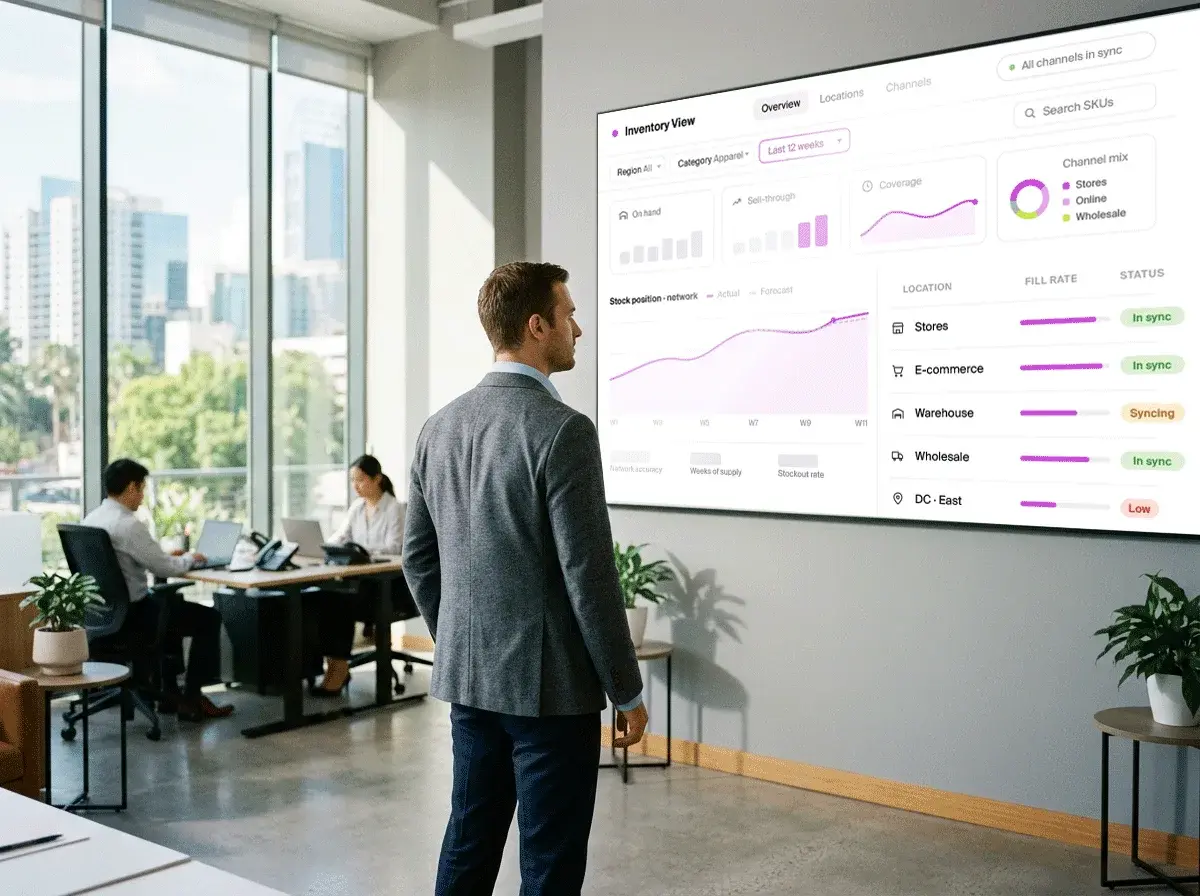
Cloud-based inventory software changes that pattern by showing counts as they happen, not after they’re complete. Managers can monitor progress from anywhere, see patterns emerging in real time and make decisions while the data is still current. Multi-language capabilities mean international or diverse teams can use the same system without translation delays. Post-count analytics compile crucial pieces of data including patterns and trends and put them together in easy to understand visuals.
The software integrates seamlessly with existing systems, meaning you don’t need to rebuild your entire technology infrastructure to implement it. Real-time visibility also means you can handle urgent situations immediately. If a category shows unexpected shortages during a count, you’re not waiting until morning to address it. You’re adjusting purchasing decisions the moment the data becomes available.
Accuracy at the point of decision matters more than perfection weeks later. By the time a traditional count report reaches your desk, half your decisions based on that data are already obsolete. Real-time systems keep you responsive to what’s actually happening in your store right now.
3. RFID Implementation for Item-Level Tracking
RFID technology represents the frontier of inventory accuracy. Rather than relying on scanners that read shelf tags or manually entered counts, RFID systems track individual items. An RFID tag on each product means no more guessing about whether that item actually exists on a shelf somewhere or has been lost in the system. RFID offers significant advantages over traditional barcode methods, providing continuous monitoring rather than spot-checking at count time. Efficiency improvements from RFID implementation often reach 45 percent faster counting than traditional methods.
4. Partial Counts and Cycle Counting Instead of Full Shutdowns
Full wall-to-wall counts, the traditional approach, require shutting down your operation or running it at skeleton crew levels. Partial counts and cycle counting break that mold entirely. Partial counts focus on specific departments or categories without requiring store closure. Cycle counts rotate through different sections continuously rather than trying to count everything at once.
This approach means your store stays operational, your staff works regular shifts and you gather inventory data without the disruption of a traditional count. Cycle counting also catches discrepancies faster because you’re constantly monitoring rather than trusting a single annual snapshot. This matters because inventory accuracy doesn’t hold steady between counts. Even when records are correct at one point, they gradually degrade as discrepancies accumulate, which is exactly why continuous validation beats periodic correction. For seasonal businesses or retailers with fluctuating inventory levels based on promotions or trends, cycle counting aligns perfectly with actual operating patterns rather than forcing data collection around an arbitrary annual date.
5. Supplemental Staffing When You Need Extra Hands
Sometimes the issue isn’t the method but the labor capacity. You have the right technology and the right process, but your team is stretched thin and bringing in overtime creates burnout and errors. Supplemental staffing fills that gap by providing trained personnel exactly when you need them, working within your existing system while your people remain in charge.
6. Scanner Rental and Equipment Flexibility
Buying inventory counting equipment requires capital investment upfront and creates fixed costs even during seasons when you don’t need to count frequently. Rental models flip that structure by allowing you to rent scanners and equipment exactly when you need it. Expedited shipping means equipment arrives quickly when an unexpected count becomes necessary. You don’t have to maintain expensive technology that sits idle most of the year.
7. Consulting and Best Practice Implementation
Technology alone doesn’t solve inventory problems. Process matters. Many retailers developed their counting procedures years ago and never reconsidered them. A consulting review identifies inefficiencies embedded in your standard operating procedures, from how you organize your back room for efficient scanning to which departments should be counted first based on your actual customer traffic patterns.
Consultants work with your team to implement best practices developed across diverse retail environments. What worked for a warehouse of one type might work even better for your convenience store with modifications. Professional implementation reduces the learning curve and prevents costly mistakes as you transition to new systems. The best technology in the world won’t help if your process is fundamentally flawed.
A good consultant also becomes your advocate for change internally. Staff resistance to new counting methods is real and common. Having an outside expert explain the benefits and demonstrate the improved results helps your team embrace the transition rather than resenting it. That buy-in determines whether implementation succeeds or fails.
The True Cost of Outdated Counting Methods
Full-service inventory counting systems engineered for this purpose are measurably faster than the methods most retailers still use. Traditional overnight counts with external contractors represent expensive solutions to what should be simpler problems. Your staff staying late. Premium rates for third-party teams. Lost sales from reduced operating hours. Stress that leads to counting errors.
The Retail Landscape is Changing
Retailers who moved away from traditional counting models report substantial time and cost savings. They also report better data accuracy because employees using familiar systems are more careful than exhausted overnight crews rushing to finish. Real-time visibility means you’re not making purchasing decisions based on counts from three months ago. Your customers experience better in-stock availability because accurate inventory information means smarter replenishment.
If your store is still doing inventory the way you did a decade ago, ask why. The answer is probably inertia rather than logic. As Professor Aris Syntetos of Cardiff Business School framed it, retailers may want to think of stock counts in a different way, as a sales increase strategy rather than an unnecessary cost. Technology solutions exist now that address every traditional objection to alternative counting methods. Cost savings materialize quickly. Accuracy improves within the first few counts. Staff stress decreases when inventory no longer means an emergency all-hands effort. The retail environment is competitive enough without handicapping your business with outdated inventory practices.
About the Author